- Home
- Sustainability
- Increasing the number of value co-creation partners
- Reduction of Scope 3 GHG Emissions in Collaboration with Suppliers
Reduction of Scope 3 GHG Emissions in Collaboration with Suppliers
Initiatives to Reduce Scope 3 GHG Emissions
The Group will strive to reduce its GHG emissions to “Creating a society that co-exists with the environment,” which is one of its materiality issues. In addition, we will take actions with an SBTi-approved long-term target to reduce GHG emissions from the supply chain (Scope 3*).
* Scope 3: Indirect emissions from activities in the entire supply chain not included in Scope 1 or 2

Approach Suppliers
As the Group is a corporate group with retail at its core, approximately 90% of its total Scope
3 GHG emissions are constituted by emissions from the production of goods and services purchased from
suppliers (Category 1) and emissions from transportation and distribution (Category 4 and 9).
In light of this situation, the Group thinks that it is important to reduce Scope 3 GHG emissions not by the
Group alone but in collaboration with suppliers.
Daimaru Matsuzakaya Department Stores whose Scope 3 GHG emissions account for approximately 87% of the
Group’s total emissions will start to approach suppliers in fiscal year 2021 to share its GHG emission
reduction targets and reduction measures with them.
FY2025 Scope 3 Emission Results
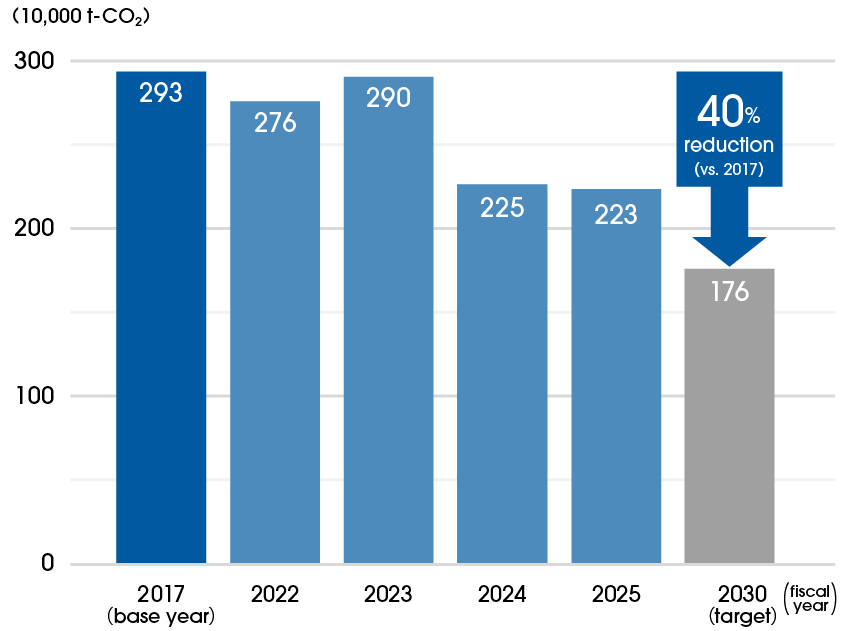
FY2025 Scope 3 emissions totaled 2,230,492 t-CO2, representing a 23.8% reduction compared with the FY2017 baseline year established under the Science Based Targets (SBT) framework. For Category 1 (Purchased Goods and Services), primary emissions data from 50 suppliers, including Scope 1, Scope 2, and upstream Scope 3 emissions, were incorporated into the calculation.
Scope 3 Emissions
FY2025 Scope 3 Emissions by Categoryunit: t-CO2, %
Category |
Emissions |
Percentage of emissions (%) |
|
|---|---|---|---|
| 1 | Purchased goods and services | 1,934,925 | 86.75 |
| 2 | Capital goods | 64,266 | 2.88 |
| 3 | Energy excluding Scope 1 and 2 | 30,322 | 1.36 |
| 4 | Upstream transportation and distribution | 3,556 | 0.16 |
| 5 | Waste from operations | 9,502 | 0.43 |
| 6 | Business travel | 5,101 | 0.23 |
| 7 | Employee commuting | 2,169 | 0.10 |
| 8 | Upstream leased assets | – | 0.00 |
| 9 | Downstream transportation and distribution | 8,604 | 0.39 |
| 10 | Processing of products | – | 0.00 |
| 11 | Use of sold products | 16,111 | 0.72 |
| 12 | End-of-life treatment of sold products | 142,304 | 6.38 |
| 13 | Downstream leased assets | 13,632 | 0.61 |
| 14 | Franchising | – | 0.00 |
| 15 | Investments | – | 0.00 |
* Category 8 is excluded from the calculation because it is calculated under Scope 1 and 2
* Categories 10, 14, and 15 are excluded from the calculation because they are not applicable to the JFR Group's business processes
Scope 3 Reduction Initiatives
Approximately 90% of the Company’s Scope 3 emissions are attributable to Category 1 (Purchased Goods and Services). As a result, reducing these emissions through the Company’s own efforts alone is challenging. Collaborative emission reduction initiatives across the value chain are essential.
To address this issue, Daimaru Matsuzakaya Department Stores, the Group’s core operating company, has engaged in dialogue with business partners based on their specific circumstances.
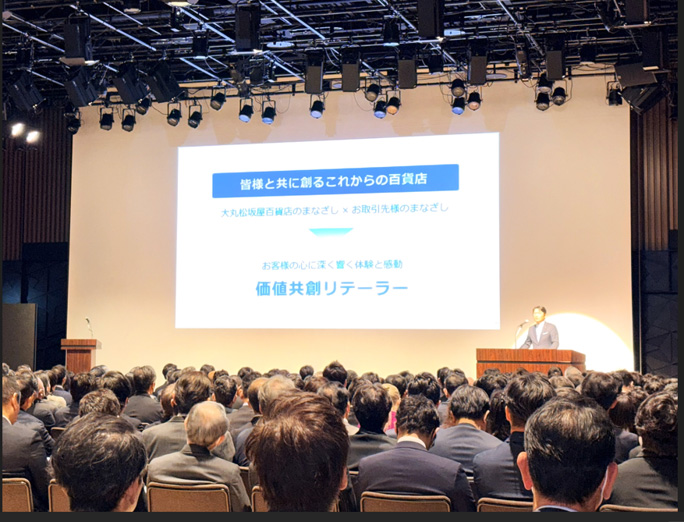
These discussions have focused on calculating GHG emissions, the establishment of reduction targets, and the provision of primary emissions data (Scope 1, Scope 2, and upstream Scope 3 emissions). In 2025, the Company also held a briefing session for our major business partners to explain our environmental initiatives and encourage them to calculate their GHG emissions (Attendance: 233 companies / 336 participants). As a result of these initiatives, Category 1 emissions for FY2025 were calculated using primary data obtained from 50 suppliers, compared with 41 suppliers in FY2024.
Consequently, Scope 3 emissions decreased by 23.8% versus the baseline year FY2017.